El sector médico se clasifica como YMYL (Your Money or Your Life), por lo que los requisitos para un perfil de backlinks son significativamente más exigentes que en otros campos. El principal problema es que muchos propietarios de sitios web donantes se niegan a publicar enlaces a proyectos de afiliados médicos, y la creación de enlaces tradicional suele tener un límite.
Decidimos probar el rendimiento de nuestros dominios en un sitio web de este tipo. Tomamos un proyecto existente, preparamos 20 enlaces, los ubicamos siguiendo un plan bien elaborado y medimos los resultados después de tres meses.
En este caso práctico, mostraremos nuestras métricas iniciales y el crecimiento que hemos experimentado desde que aparecimos en nuestras plataformas. Este material será útil para especialistas en SEO, propietarios de agencias y quienes gestionan proyectos de afiliación médica que buscan formas efectivas de generar enlaces en un nicho complejo.
Por qué los enlaces PBN son importantes en un estudio de caso de un sitio web de afiliados médicos
El sector médico es uno de los más competitivos en SEO. Grandes clínicas, portales gubernamentales y publicaciones médicas de prestigio compiten por los primeros puestos en los resultados de búsqueda. Es prácticamente imposible que un sitio web de afiliados típico se posicione bien solo con contenido. Los enlaces son esenciales, y se necesitan muchos.
El problema radica en que los enlaces, directorios y artículos de invitados generados por la comunidad en el ámbito médico suelen tener un rendimiento deficiente. Los donantes con alto índice de referencia (DR) suelen pertenecer a nichos relacionados (ejercicio físico, estilo de vida saludable, nutrición), por lo que su autoridad de enlace es menos efectiva. Google identifica rápidamente los enlaces comprados directamente desde sitios de noticias o irrelevantes.
En este sentido, los enlaces PBN ofrecen tres ventajas importantes:
- Control sobre los donantes. Usted elige sitios con una temática, un índice de donaciones y un historial adecuados.
- Flexibilidad en la lista de enlaces de anclaje. Puedes crear un perfil natural con enlaces de marca, enlaces sin anclaje y enlaces parcialmente comerciales sin cruzar la línea del spam.
- Resultados predecibles. Cuando se configuran correctamente, entre 20 y 30 enlaces PBN proporcionan un aumento del tráfico y del posicionamiento que se puede medir y planificar.
En nuestro caso, fueron estos tres factores los que nos llevaron a elegir una red de blogs privados (PBN) en lugar de la creación de enlaces basada en la participación de la audiencia o de los visitantes.
Punto de partida del sitio web del afiliado médico
Un cliente nos contactó con un sitio web de afiliados médicos. El proyecto llevaba funcionando poco más de un año y operaba en un nicho altamente competitivo. La mayor parte del tráfico se dirigía a páginas informativas, y las consultas comerciales apenas figuraban entre los 10 primeros resultados.
Antes de empezar a publicar, registramos el rendimiento actual del sitio (febrero):
| Métrico | Antes de la campaña (febrero) |
| Tráfico orgánico (mensual) | ~250 |
| Dominios de referencia | 30–35 |
| Número de palabras clave en el top 10 | mínimo (50–70 puestos en todo el sitio) |
| Posición media para consultas comerciales | por debajo de 20 |
La dinámica de los dominios de referencia durante los dos meses previos a la solicitud se mantuvo prácticamente sin cambios. El crecimiento se situó en torno a uno o dos dominios nuevos por semana, procedentes principalmente de directorios y plataformas de crowdsourcing. El perfil de backlinks del sitio le impedía competir con los primeros resultados de búsqueda.
Al analizar el historial del proyecto, observamos que, antes de contactarnos, el sitio ya había experimentado cierto crecimiento, pero luego experimentó un declive: el posicionamiento bajó y el tráfico disminuyó. Las razones podrían ser diversas, desde actualizaciones del algoritmo de Google hasta la estacionalidad o fluctuaciones naturales del nicho. El cliente alcanzó su punto más bajo en febrero y, en ese momento, decidió implementar cinco PBN en páginas comerciales clave, solicitando nuestros servicios.
El resultado de la colocación en nuestros donantes
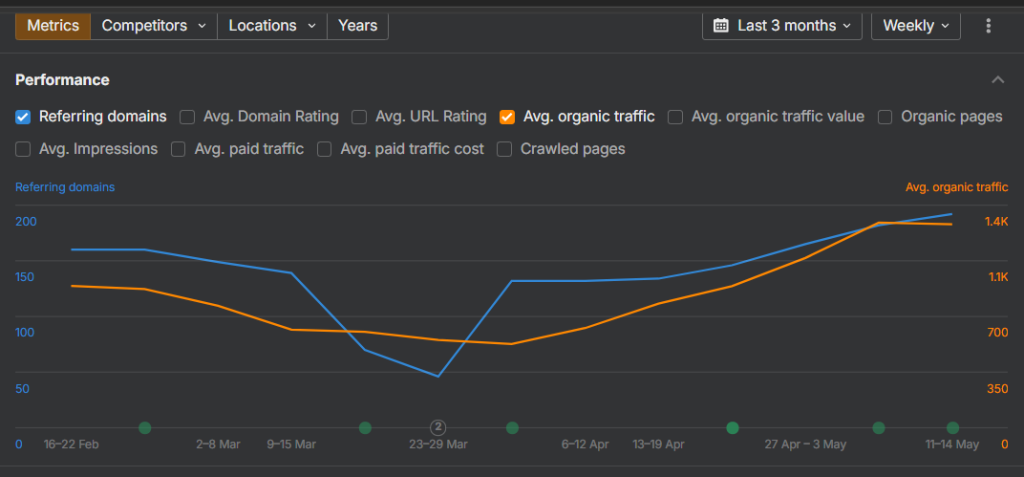
Tras insertar cinco enlaces, monitorizamos su dinámica utilizando herramientas SEO estándar. Nos centramos en dos métricas: el número de dominios de referencia y la distribución de los resultados de búsqueda.
La captura de pantalla que se muestra a continuación ilustra cómo varió el número de dominios de referencia a lo largo de tres meses. En febrero, la cifra rondaba los 30-35. A mediados de mayo, había aumentado a 140-150. Esto no significa que todo el crecimiento se deba a los cinco enlaces de la red privada de blogs (PBN); algunos dominios se adquirieron de forma orgánica o como resultado de otras actividades. Sin embargo, el gráfico muestra claramente que el perfil de enlaces del cliente no se ha estancado, sino que está creciendo.
зображення_2026-05-14_152418656.png
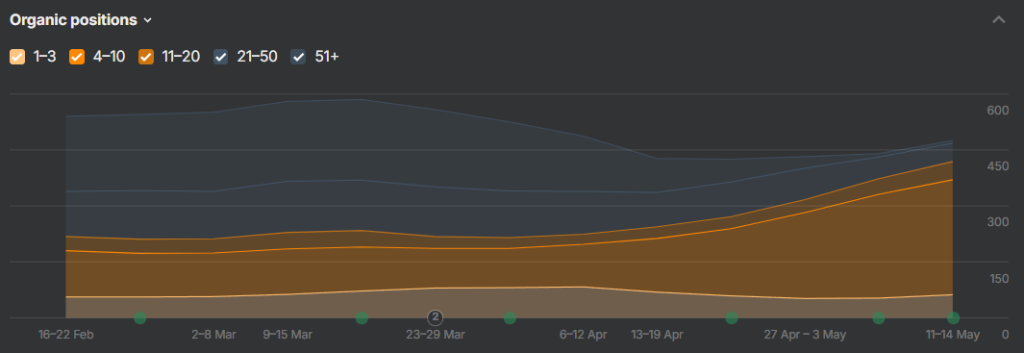
La segunda captura de pantalla muestra los cambios en el posicionamiento. Si bien en febrero la cantidad de palabras clave entre los 3 y 10 primeros puestos era mínima, a finales de abril la situación había cambiado. El número de posiciones entre el 4 y el 10 aumentó significativamente, mientras que la proporción de palabras clave fuera de los 50 primeros puestos disminuyó. Esto significa que los motores de búsqueda comenzaron a percibir el sitio como más relevante para las consultas objetivo.
зображення_2026-05-14_152643424.png
El tráfico orgánico aumentó de aproximadamente 250 sesiones mensuales a un nivel estable de entre 1000 y 1100. Al mismo tiempo, las impresiones disminuyeron de 1100 a aproximadamente 100. Este cambio, aparentemente paradójico, sugiere que el sitio dejó de aparecer en búsquedas irrelevantes y comenzó a atraer a una audiencia más pertinente.
El cliente consideró que este resultado era suficiente para la primera fase. Los cinco enlaces actuaron como detonante: no hicieron todo el trabajo por el sitio, pero sí iniciaron el proceso de mejora del posicionamiento.
Cinco enlaces es una cifra pequeña para el sector médico, altamente competitivo. Sin embargo, incluso esta presencia limitada generó un aumento significativo del tráfico orgánico e impulsó las páginas comerciales a mejores posiciones en el ranking.
Por qué funcionó. Los donantes fueron seleccionados en función de su relevancia y un historial impecable. La lista de enlaces no contenía palabras clave comerciales predefinidas; se utilizaron frases de marca, sin enlaces y genéricas. Los enlaces dirigían a diversas páginas internas, no solo a la página de inicio.
¿Cómo consolidaríamos el resultado?
Para fortalecer su posición y ampliar su éxito, le sugerimos agregar otros 20 enlaces, distribuyéndolos en tres áreas:
- De 5 a 7 enlaces a la página de inicio para aumentar la autoridad general del dominio;
- De 8 a 10 enlaces a esas páginas comerciales que llegaron al top 20, para impulsarlas hasta el top 5;
- El resto son artículos de apoyo que forman un núcleo semántico en torno a las consultas objetivo.
Al mismo tiempo, conviene ampliar la lista de textos de anclaje con frases LSI y palabras clave naturales como “más información sobre el procedimiento”, “casos de estudio” y “opiniones de pacientes”. Esto reducirá el riesgo de spam y hará que el perfil parezca aún más natural.
Las colocaciones se distribuirían a lo largo de 8 a 10 semanas, ya que la aparición gradual de nuevos donantes le parece más natural a Google que un salto brusco.
Con este enfoque, 20 enlaces PBN adicionales no solo nos permitirían mantener nuestros resultados actuales, sino también llevar el sitio al siguiente nivel de competencia, situándolo entre los 5 primeros para las consultas comerciales clave.
Riesgos, preocupaciones sobre las penalizaciones de Google y medidas de seguridad
Trabajar con una red de blogs privados (PBN) conlleva riesgos. Google establece explícitamente en sus directrices para webmasters que los enlaces procedentes de redes de blogs privados se consideran una infracción de sus normas. En el nicho YMYL (Your Money or Your Life), estos riesgos son mayores, ya que los algoritmos analizan estos sitios con mayor rigor.
Riesgos, preocupaciones sobre las penalizaciones de Google y medidas de seguridad
Trabajar con una red de blogs privados (PBN) conlleva riesgos. Google establece explícitamente en sus directrices para webmasters que los enlaces procedentes de redes de blogs privados se consideran una infracción de sus normas. En el nicho YMYL (Your Money or Your Life), estos riesgos son mayores, ya que los algoritmos analizan estos sitios con mayor rigor.
No afirmamos que las redes de blogs privados (PBN) sean una herramienta segura. Sin embargo, bajo ciertas condiciones, los riesgos pueden reducirse a un nivel aceptable.
¿Cuáles son los riesgos?
- Si Google identifica una red de donantes como una única PBN, todos los sitios que la componen pueden perder posiciones en los rankings o ser indexados por completo.
- Incluso sin sanciones explícitas, Google podría simplemente ignorar la importancia de dichos enlaces. Este es un escenario menos agresivo: las clasificaciones no caen drásticamente, pero tampoco mejoran.
- Si los enlaces de PBN conducen al sitio web de un cliente y los donantes son penalizados, esto puede afectar negativamente al proyecto objetivo.
Pero esto no significa que estos matices puedan eliminarse si se actúa correctamente.
Cómo mitigamos los riesgos en nuestro caso anterior
El cliente publicó solo cinco enlaces. Este volumen no genera ninguna actividad anómala que los algoritmos puedan detectar fácilmente.
Los donantes fueron seleccionados según los siguientes criterios:
- la presencia de un perfil de enlace natural;
- ausencia de signos evidentes de spam (enlaces rotos, contenido automatizado, gran cantidad de enlaces salientes en la página);
- diferentes registros de dominio (diferentes registradores, datos whois);
- diferentes entornos SEO (hosting, CMS, temas).
La lista de enlaces no contenía frases comerciales directas. Se utilizaron frases de marca, sin enlaces y genéricas. Esto redujo la probabilidad de que Google identificara el enlace como comprado. Además, los enlaces no se añadieron todos a la vez, sino a intervalos, para que el crecimiento pareciera natural.
Lo que recomendamos a los clientes al trabajar con PBN
Nuestra experiencia demuestra que existen maneras de evitar las sanciones. Por ejemplo:
- No utilices las PBN como tu única fuente de enlaces. Lo ideal es que los enlaces de las PBN complementen tu perfil orgánico, no que lo reemplacen.
- Supervise periódicamente el estado de los sitios web donantes. Si un sitio web desaparece del índice o es penalizado, lo mejor es eliminar el enlace o deshabilitarlo mediante la etiqueta nofollow.
- Evita colocar más de 10-15 enlaces PBN al mes en un sitio web nuevo. Un aumento repentino en el número de dominios de referencia llama la atención de los algoritmos.
En el nicho YMYL (Your Mind Your Life), también recomendamos reforzar otras señales de confianza: autores con formación médica, enlaces a investigaciones, políticas de privacidad e información de contacto.
En nuestro caso, el cliente logró crecimiento sin penalizaciones, pero esto no garantiza resultados futuros. Cualquier expansión de una campaña debe ir acompañada de la misma cautela.
Preguntas frecuentes
1. ¿Qué son los enlaces PBN y por qué funcionan en el sector médico?
Las PBN (Redes de Blogs Privados) son enlaces provenientes de redes de blogs privadas creadas específicamente para transferir autoridad de enlace a un sitio web objetivo. En el nicho médico, pueden ser efectivas debido a la escasez de donantes de alta calidad con temas relevantes y la intensa competencia por los primeros puestos. Si se implementan correctamente, las PBN permiten un crecimiento controlado de enlaces donde los métodos tradicionales de creación de enlaces fracasan.
2. ¿Es seguro utilizar PBN para un sitio web de afiliados médicos?
Sí, esto conlleva riesgos. Google considera que las PBN infringen sus normas, especialmente en temas YMYL (Your My Little Pony). Sin embargo, con un volumen de enlaces reducido (5-10 al mes), una selección de enlaces de alta calidad y una lista de enlaces ancla naturales, la probabilidad de penalizaciones puede disminuir. En el caso presentado, el cliente no sufrió consecuencias negativas, pero no se puede garantizar la seguridad.
3. ¿Por qué usaste solo 5 enlaces y no más?
El cliente decidió, por iniciativa propia, comenzar con 5 enlaces para probar la respuesta del sitio web. Este es un enfoque razonable: primero, asegurarse de que no haya dinámicas negativas y, luego, aumentar la cantidad de enlaces. En el sector médico, un inicio tan prudente es preferible a una expansión agresiva.
4. ¿Qué resultados se pueden esperar de 5 enlaces PBN?
Como demuestra nuestro caso práctico, cinco enlaces pueden aumentar el tráfico orgánico de 250 a 1000-1100 sesiones mensuales y posicionar las páginas comerciales entre los 10 primeros resultados. Sin embargo, esto depende en gran medida del estado actual del sitio, la calidad de los donantes y la competitividad de las consultas de búsqueda. Los enlaces de PBN actúan como un catalizador, no como una solución milagrosa.
5. ¿Qué debo hacer si mi posicionamiento baja después de colocar enlaces PBN?
Primero, verifica el estado de tus donantes: si han sido sancionados o han desaparecido del índice. Luego, evalúa tu lista de enlaces ancla para asegurarte de que no haya spam de palabras clave comerciales. Finalmente, suspende temporalmente la colocación de nuevos enlaces y refuerza otras señales de confianza: contenido, factores de comportamiento y menciones orgánicas. Si la caída coincidió con una actualización de Google, conviene esperar de una a dos semanas; las clasificaciones suelen recuperarse por sí solas.